
Benicia City Directory Collections
The verified Benicia city directory set is useful precisely because it is described with care. The library confirms city directories inside licensed databases but does not publish a complete Benicia shelf inventory. The entries below are the specific issues, runs, and companion collections identified in the research, with gaps left visible rather than filled by an assumed continuous series.
| Collection | Years | Where held | Access and value |
|---|---|---|---|
| Solano and Napa Counties Directory | 1871-72 | Huntington Library and Solano County Genealogical Society | Rare-book or society research; earliest verified resident issue |
| Solano section | 1874 | Solano County Genealogical Society | Exact date is verified; entry format remains unverified |
| McKenney's district directory | 1878-79 | SCGS and FamilySearch catalog 703760 | Resident and landowner clues; some landowner acreage and post-office details |
| McKenney issue | 1884-85 | Solano County Genealogical Society | Discrete issue, not proof of annual coverage |
| Napa and Solano Counties telephone directory | November 1928 | Museum of History Benicia | Subscriber, telephone number, and party-line letter; about 2.5 Benicia pages |
| Licensed city-directory databases | Collection-dependent | Benicia Public Library | Card or in-library access; exact Benicia years require catalog or reference confirmation |
There is no verified continuous Polk run or final printed year in the local research. A directory search should name the volume and year used, especially when a missing year affects the family trail.
- 1871-72: earliest verified county directory that explicitly includes Benicia.
- 1874: discrete Solano section held by SCGS; entry format is unverified.
- 1878-79: McKenney directory adds resident and selected landowner clues.
- 1884-85: another discrete McKenney issue, not proof of annual coverage.
- November 1928: Museum telephone book; a final printed city-directory year is not verified.
Benicia's Earliest Verified Directory
The 1871-72 Solano and Napa Counties Directory is the earliest verified resident directory found for Benicia. The title explicitly includes Benicia among the covered towns, and the Huntington Library holds the rare-book record under call number 348101. The Solano County Genealogical Society provides a local research fallback. This issue can place a name in the early city, but it should not be described as a complete household list.
The 1874 Solano section and the 1878-79 McKenney volume extend the trail without creating a false annual run. McKenney's title promises all residents, while landowner entries add acreage and post-office address. Those details can connect a person to land or a postal place, yet the entry remains a period clue. The deed record remains the stronger source for ownership.
Benicia Historical Society house-history links explain how the early directory material fits with maps, surveys, and local collections.
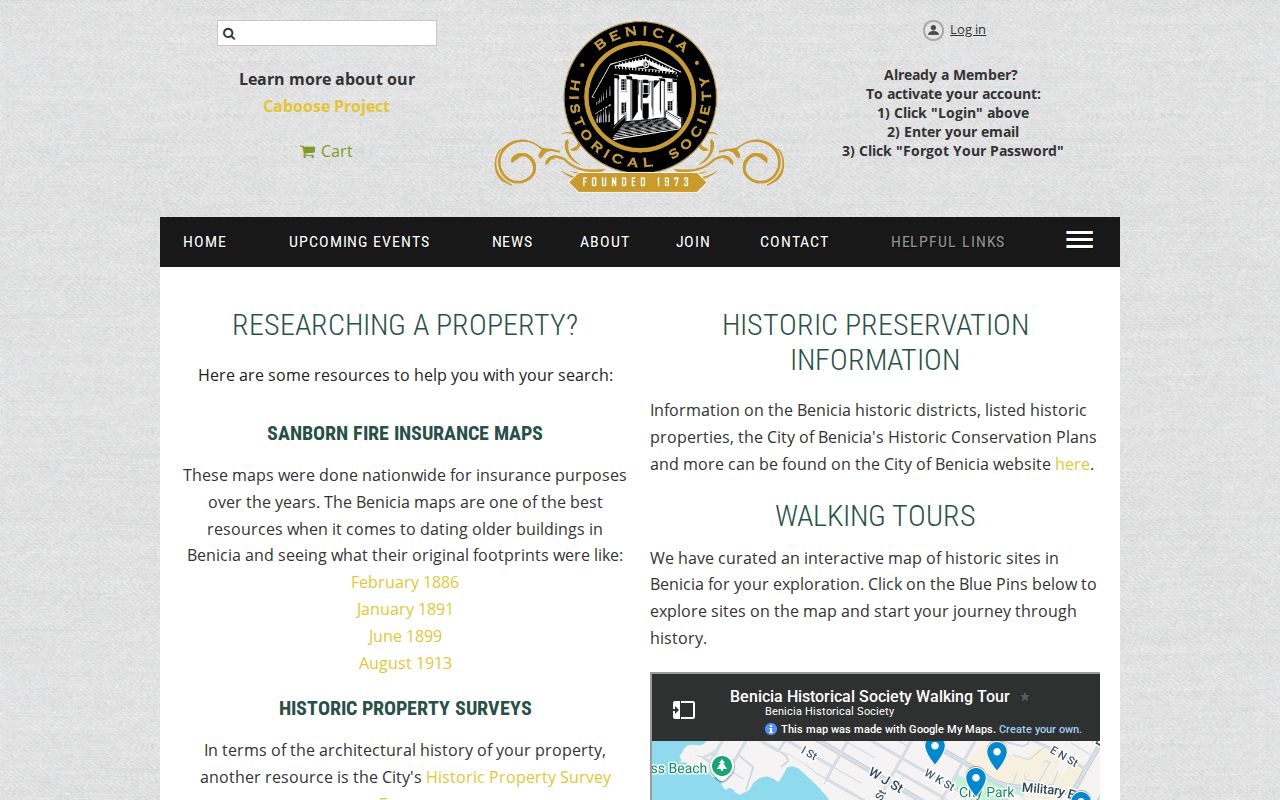
The house-history capture points toward the local method: directory clues gain meaning when paired with an address, map, or dated building record.
McKenney's 1878-79 Benicia Clues
McKenney's 1878-79 district directory is a useful comparison to the later telephone book. It can provide a resident name and, for a landowner entry, acreage and post-office address. The information is tied to the edition's coverage and the way its compiler gathered names. A person who is absent may have moved, been omitted, or fallen outside the volume's method.
| Directory genre | Verified clue | How to use it |
|---|---|---|
| 1878-79 McKenney | Resident name; landowner acreage and post-office address where catalog evidence supports it | Anchor a person to a year and broad place, then check land and newspaper records |
| 1928 telephone book | Subscriber/name, telephone number, and a trailing party-line letter | Identify a telephone subscriber without assuming one number equals one household |
| Licensed city-directory database | Potential name-to-address or address-to-name search, volume dependent | Verify the actual Benicia issue and its field layout before quoting an entry |
The comparison is a reminder that a Benicia directory can mean a resident directory, a telephone subscriber list, or a database scan. Each genre has a different level of proof.
The 1928 Benicia Telephone Book
The Museum of History Benicia holds a November 1928 Napa and Solano Counties telephone directory, object 2017.030.0487. Benicia fills about two and a half pages. The museum record supports a title, object ID, collection, date, publisher, geographic coverage, subscriber or name, telephone number, and a trailing letter that marks a party line.
That letter is an important local quirk. A party-line number could serve more than one subscriber, so the telephone book is not a modern household census and is not proof that one person occupied the address. It is still valuable for a name, a business connection, or a period telephone clue when matched to newspapers or a later record.
The Museum of History Benicia collections entry is the route for deeper object and archive research.
Note: The 1928 telephone sample supports subscriber and phone fields, not a spouse, occupation, or owner mark that the object does not show.
Reading a Benicia City Directory Entry
A historical city directory entry must be read as an object from a specific volume. The 1928 local phone book supports subscriber and telephone fields. The McKenney catalog supports resident names and some landowner details. Licensed database marketing may describe broader fields, but the exact Benicia publisher, year, and scan must be checked before treating a field as local fact.
| Subscriber or name | Verified for the 1928 telephone directory; a city-directory volume may use a surname, given name, or initial. |
|---|---|
| Telephone number | Verified for the 1928 telephone directory, including its party-line letter. |
| Address | May appear in a resident or reverse section; verify the chosen Benicia volume. |
| Occupation | A common directory field, but not verified for a specific Benicia issue in the public sample. |
| Spouse or household mark | Possible in some directory genres; do not add it to the 1928 phone-book sample. |
| Owner or renter mark | May occur in some city-directory layouts; confirm the edition's key before reading a symbol. |
- Criss-cross section
- A street-order section that can turn an address into a name for the years in which the volume includes it.
- Householder index
- A name or household finding aid, whose scope depends on the volume and compiler.
- Abbreviation key
- The volume's guide to short forms and symbols; photograph or note it before interpreting entries.
Do not let a familiar abbreviation create a false fact. The surrounding page, publisher, year, and address context control the reading.
Benicia Newspaper Records Bridge 1899-1977
Benicia's newspaper run supplies a stronger continuous local spine than the verified city-directory issues. The Benicia Public Library lists The Herald for 1899-1914 and 1972-1977, Benicia Herald and New Era for 1914-1957, and Benicia Herald for 1958-1971. Births, deaths, moves, club notices, property sales, and community events can bridge the years between directory editions.
The library's Newspaper Archive requires a card for remote use, while the library link supplies on-site access without that remote login. Search the person's name with the street, spouse, organization, or event. OCR can miss names, so a date range and a second spelling can matter as much as the first query.
The Benicia Public Library database list gives the title ranges and access notes.
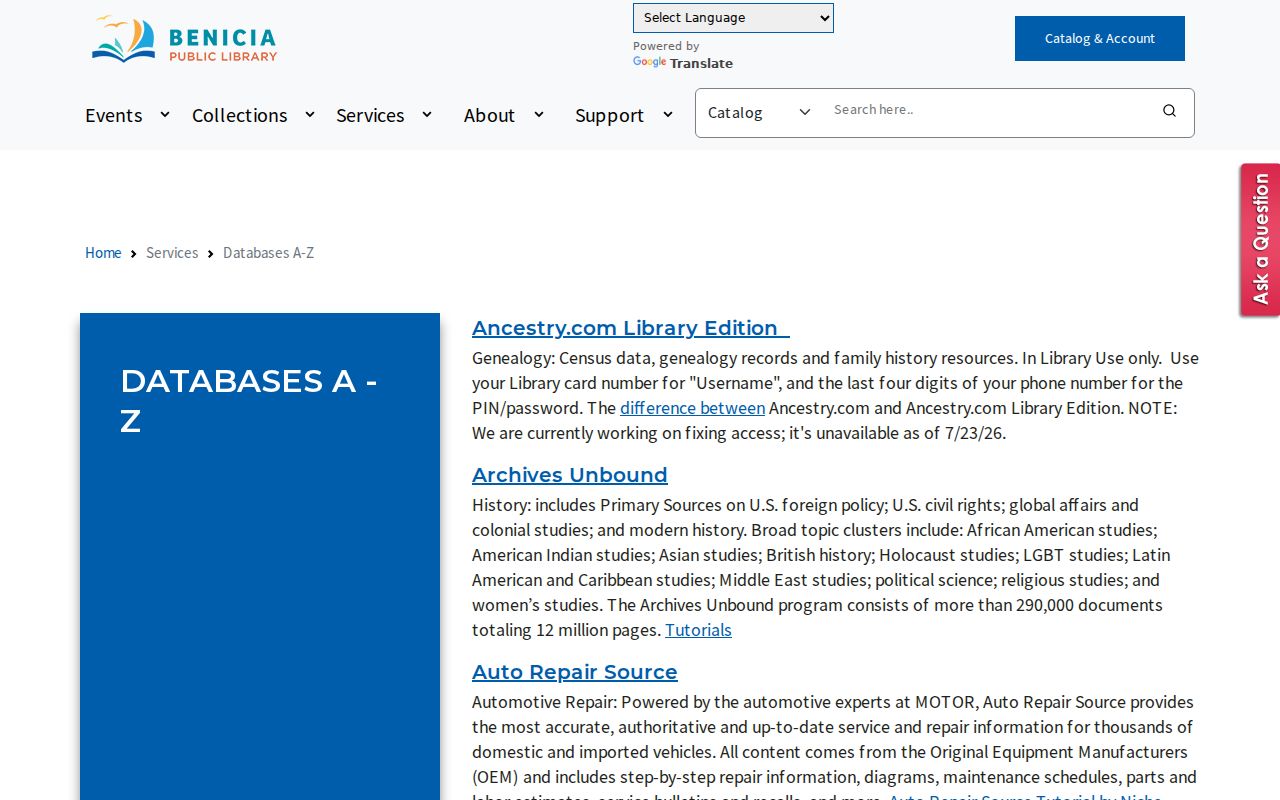
The newspaper database capture shows why a notice or move can fill a gap that no directory issue covers.
Trace a Benicia City Directory Household
A city directory is most useful when its year sits inside a larger household timeline. The federal census is public through 1950 under the current release rule. A directory issue or newspaper can fill the years between census schedules, while a deed, obituary, or cemetery row can explain a move or death.
- Anchor the household in a public census year, keeping names, ages, relationships, occupation, and geography together.
- Search the verified directory issue nearest that census year and record the exact address and spelling.
- Use a street or reverse section only if the chosen volume actually contains one, then note nearby names as clues.
- Search the Benicia newspaper titles for the name, address, spouse, sale, move, or death notice.
- Close the trail with a deed, probate docket, cemetery index, or later census rather than assuming an absence means a move.
Disappearing from one Benicia directory can mean a move, death, omission, a changed publication method, or a gap in the collection. The next dated source decides which explanation is strongest.
Benicia Public Library genealogy access links the licensed databases that can bridge a directory year to census, land, church, obituary, and map material.
The genealogy capture represents the library-card and in-library routes that make a directory search wider than one printed volume.
The modern parcel and deed chain belongs to the Benicia street directory workflow; the historical directory itself should remain tied to its verified edition.
Benicia SCGS Collections Beyond Directories
The Solano County Genealogical Society expands the historical shelf with local and county indexes. Published holdings include Benicia City Cemetery, Barracks Cemetery and St. Dominic's records; fifteen church-register indexes or copies; a Great Register run from 1866-1968; a naturalization index from 1851-1962; a death database from 1850-2016; and deed, court, map, and newspaper indexes. Those are collection dates, not a promise that every person or year survives.
Church and cemetery material can reconnect family or community networks when a printed directory is silent. Great Register entries concern historically eligible voters and should not be treated as a complete resident list. Naturalization records can provide a place and date clue, while deed indexes can tie a name to land. Each series has its own access rules and finding aids.
Note: Regional holdings are strongest when a known Benicia name, organization, address, or date narrows the request.
Benicia Sanborn Records Explain Addresses
Sanborn fire-insurance maps are a companion to a printed directory, not a substitute for one. Benicia has four useful editions: February 1886, January 1891, June 1899, and August 1913. The first focuses chiefly on First Street. The 1891 edition adds the Arsenal and East Fourth and I Street areas. The 1899 edition shows expansion along I and J streets toward West Eighth.
A map can show a footprint, use, outbuilding, lot or block context, and a street number in its surveyed area. It cannot name every occupant. When an address disappears from a directory, compare the map, deed legal description, historic survey, and newspaper before concluding that the structure or household vanished.
The Library of Congress Benicia Sanborn item is the digitized 1899 reference identified in the research.
Benicia Directory Museum and Archive Leads
The Museum of History Benicia reports roughly 29,000 growing catalog entries across photographs, artifacts, documents, and narratives. The online archive can supply names in organizational records, memorial ephemera, and building stories that a directory never recorded. Deeper research is available by appointment, with the research service listed at $35 per hour Tuesday through Friday from 10 a.m. to 4 p.m.; high-resolution scans are listed at $10 each for the first five and $5 thereafter.
The National Archives at San Francisco is another regional route for federal and military material. That matters in Benicia because Arsenal personnel, wartime rosters, newsletters, and federal records may place people who are absent from ordinary city books. Use a directory entry to create the name and date clue, then ask the archive or museum for the series that actually holds the evidence.
National Archives at San Francisco research access supplies the regional federal archive route.
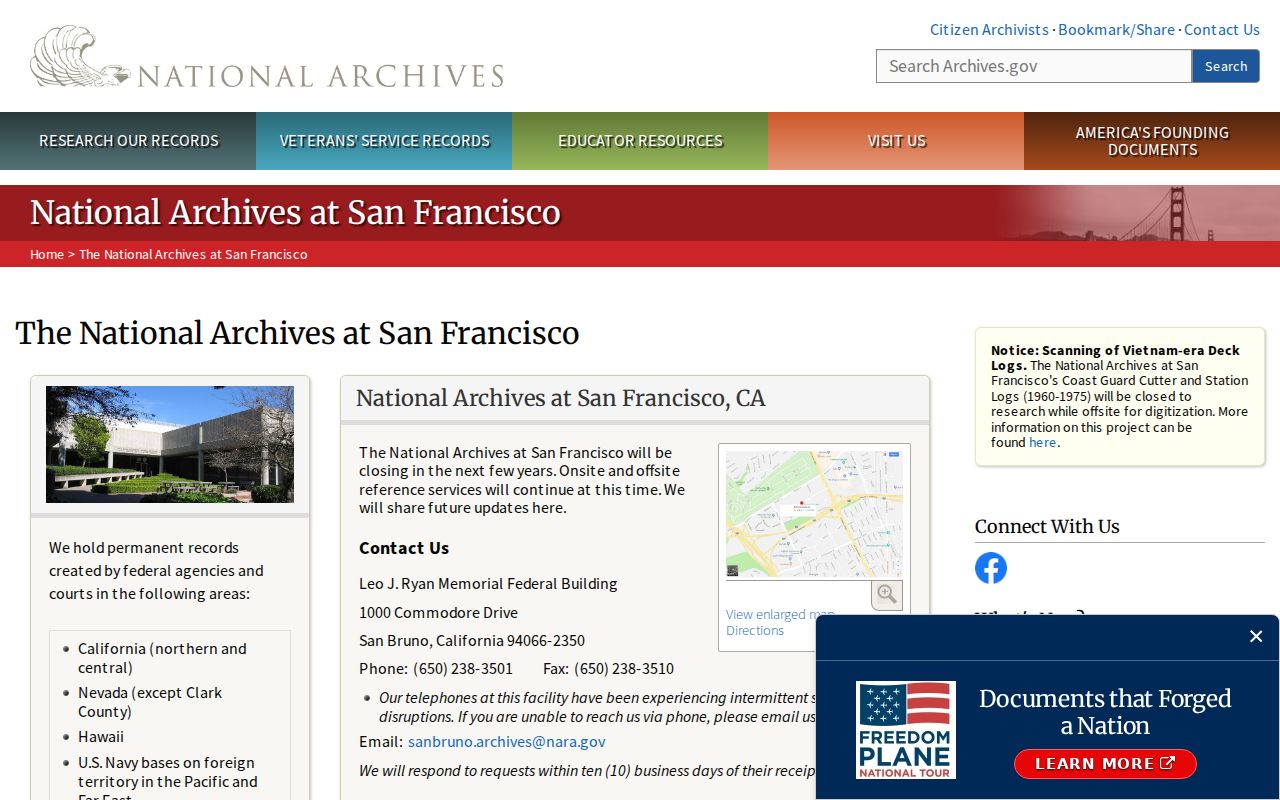
The archive capture belongs to the federal research layer that can complement, rather than replace, a local city directory.