
How Benicia Residents Are Found
A Benicia residents directory search goes smoothly once the first question is settled. Who do you want, and why? A current owner hangs on a parcel or a recorded deed. A registered voter shows up only through a self-check or a qualified file request. Court parties live in a case index. A business name may point to a county fictitious-business-name filing or a California entity record. Older households surface in newspapers. Census schedules, cemetery indexes, and dated directory volumes add more.
No single roll proves occupancy. Ownership and occupancy can differ. Voter rolls are not a street browser. A directory entry only covers its own year. So begin with the strongest clue, keep the time period in view, and confirm a name match with a second record type before trusting it.
- Use the Solano property search or parcel maps when an address or APN is known.
- Use California My Voter Status only for the voter's own authenticated status, or request a voter file for a permitted purpose.
- Search the Solano recorder by grantor, grantee, document type, and date after an owner or party name is known.
- Use Benicia library newspapers, city-directory collections, and historical indexes for an earlier resident or household.
- Ask the named custodian for an existing record when the needed material is not online.
Benicia Resident Records Offices
Benicia is an incorporated city inside Solano County. Fairfield holds the county seat. That split shapes everything. City offices keep municipal permits, historic-property forms, agendas, and other city records. The county offices in Fairfield hold the property, recorded-document, court, vital, marriage, and voter material that powers a Benicia residents directory, while state agencies add licenses, business filings, custody records, and privacy programs.
Solano County Assessor/Recorder
675 Texas St., Suite 2700
Fairfield, CA 94533
(707) 784-6200
Solano County Assessor
675 Texas St., Suite 2700
Fairfield, CA 94533
(707) 784-6210
Solano Registrar of Voters
675 Texas St., Suite 2600
Fairfield, CA 94533
(707) 784-6675
Solano County Clerk
675 Texas St., Suite 1900
Fairfield, CA 94533
(707) 784-7485
Sometimes an online index hides the field you need. That is when the counter matters. The Assessor handles in-person ownership, value, and property-characteristic research weekdays from 9 a.m. to 4 p.m., and the Recorder supplies its own copy and research route.
Benicia Resident Search: Name, Address, APN
Three starting clues, three different trails. A name fits CourtConnect, the fictitious-business-name index, a license search, or a historical newspaper. An address fits the Solano property portal and Benicia permit history. It also fits ReGIS parcel maps and address-organized historic surveys. An APN bridges the parcel to the recorded-document index. The Recorder's public index stores no street addresses, so the APN does that work. Each clue opens a different door.
Whatever the clue, preserve it exactly as found. Write down the street number, street name, date range, and spelling variants. Resolve the parcel first if the clue is an address. Add a place or time to a name before opening a court or deed result. For an old household, pair a directory year with a census year. Do not assume the later person is the same resident.
- Roll
- A government-held list or account, such as an assessment or voter file, organized for an official purpose.
- Index
- A finding aid that points to a record or filing; an index line is not the full document.
- Parcel
- A mapped piece of land with an assessor identifier, separate from a street address or mailing address.
- Criss-cross directory
- A reverse section arranged by street or address, when a historical volume includes one.
The address-first method keeps the Benicia residents directory anchored to a real place. It still leaves room for gaps between ownership, occupancy, and history. Once a party name is known, the Solano Official Records search is the right next step for documents. The Recorder search page for Benicia displays the official starting point for indexed documents. From that screen, a name or date does the work an address cannot.
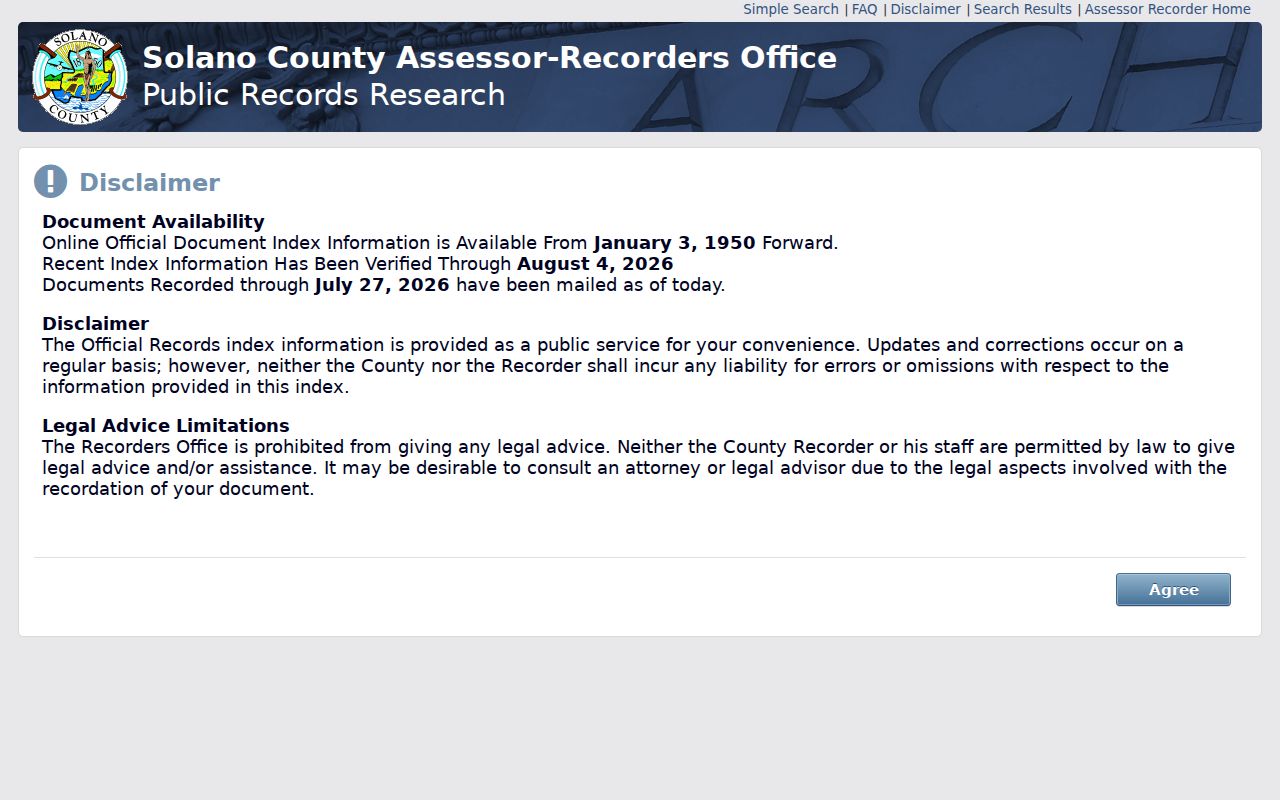
The page shown belongs to the county's recorded-document search. There, a name, a date clue, or a document term stands in for the address query the index cannot run.
Benicia Recorder Records Have No Address Field
Solano's Recorder FAQ states the core limitation plainly. No addresses are stored in the official-records database. Simple Search takes a free-text mix of party name, year, or record word. Advanced Search splits grantor and grantee names, a document-date range, and document type. A deed-chain search therefore starts at the property or Assessor counter and then pivots to the people named in the indexed document, which is how a Benicia residents directory gets built backward from paper.
| Search control | How it helps a Benicia record search |
|---|---|
| Simple Search | Combine a party name, date clue, and document word; punctuation is optional. |
| Grantor/Grantee | Search the surname and given name in either role when following title. |
| Document date from/to | Narrow a broad name match to the period of a sale, lien, or release. |
| Document type | Use a known class such as deed, lien, or release; the full list is not exposed in the public FAQ. |
| Search or Enter | Submit the entered terms; the results identify indexed documents and type. |
The index names parties and document type. It cannot replace the image or the legal description. Vesting language and proof of current ownership are not in the index either. Search the seller as a grantee in the earlier period. Then inspect the paired recording details. Step further back after that. Copies can be requested at the Fairfield public research area or by mail once a document number, party name, date, or book-and-page clue is in hand. The county's copy instructions control the fee and payment method.
Note: A lien hit needs a matching release or reconveyance search before it is treated as a current obligation.
Benicia Property Evidence at the Fairfield Counter
The Solano property portal accepts an APN or street address. Less information often returns more matches. Compass prefixes and street-type endings like ST, LN, and AVE can be dropped. This helps when a query comes up empty. The public search is a parcel lead, nothing more. It does not promise that an owner name or mailing address will appear online. The Assessor notes that errors and omissions are possible. Current ownership research waits at the Fairfield counter.
That line keeps official rolls apart from commercial compilation tools. An official custodian controls the record and its correction path. A compilation may merge stale sources, lag behind changes, or attach the wrong person to a common name. For family history, a property lead, or a fraud check, the official record should always be the confirmation point. That holds in any Benicia residents directory search.
| Source | Strength | Limit |
|---|---|---|
| Solano Assessor and Recorder | Custodian-held parcel, assessment, deed, lien, and release evidence | Address-to-owner access may require the counter; the deed index has no address field. |
| Historical library and museum collections | Period names, addresses, photographs, notices, and community context | Coverage is time-specific and spelling or OCR can fail. |
| Commercial compilation category | May offer a quick lead across many source types | Source age, matching logic, and update timing are not the custodian's guarantee. |
Current Benicia Resident Directories
No single record lists every Benicia household today. Instead, current resident evidence lives in records built for other jobs. The assessor's property roll ties an owner to a parcel. A recorder's document index names parties to deeds and liens. CourtConnect surfaces public case parties, and a business or license search reveals an affiliation. The library's historical city directory collections sit in an earlier layer of time, useful for past residents rather than present ones.
| Source | Relationship shown | Keeper | Access |
|---|---|---|---|
| Solano property search | Parcel, address, assessment, and property characteristics | County Assessor | Online lead; counter research |
| Official Records index | Grantors, grantees, deeds, liens, releases, and dates | County Recorder | Online index; counter or mail copies |
| My Voter Status | Authenticated voter's own status and districts | California Secretary of State | Self-lookup only |
| CourtConnect | Public case party, role, type, dates, and status | Solano Superior Court | Account, clerk counter, or Form 4021 |
| Library and museum records | Newspaper, directory, photograph, organization, and building clues | Benicia Public Library and Museum | Card, web, on-site, or appointment route |
Pick the source that actually answers your question. Then check it against a second one that measures something different. A deed lists parties, not occupants. A business index entry is not a residential address either. A broad Benicia residents directory search often narrows to verifying one person's identity. The resident lookup page takes over at that point.
CourtConnect and Solano Clerk Copies
Solano Superior Court runs CourtConnect, a free public index that opens after account registration. A public result may show the case number, caption, party names and roles, case type, filing date, register-of-actions events, and current status. Sealed, confidential, juvenile, adoption, and protected family material stays excluded or restricted. Treat a name match as a lead only. The court index is not a unique-person identifier.
For deeper access, the clerk's counter or Form 4021 is the route. Bring government photo identification. The court caps each requester at five cases per day. It accepts a written request with a known case number or a precise name and record description. Form 4021 can go by mail to the civil, criminal, family, or probate division. Payment goes by the methods stated on the form.
| Search over ten minutes | $15 per name |
|---|---|
| Copy | $0.50 per page per side |
| Certification | $40 per document |
| Federal comparison | PACER is separate; the Northern District of California lists $0.10 per page in 2026, with its stated cap and quarterly waiver. |
CourtConnect and the Solano court records and fees page identify the current public search and copy routes.
The Superior Court online-services hub is the better starting point when a division, account, or request form is unclear.
The captured Solano Superior Court online-services screen shows the county-level court entry point used for a Benicia residents directory check.
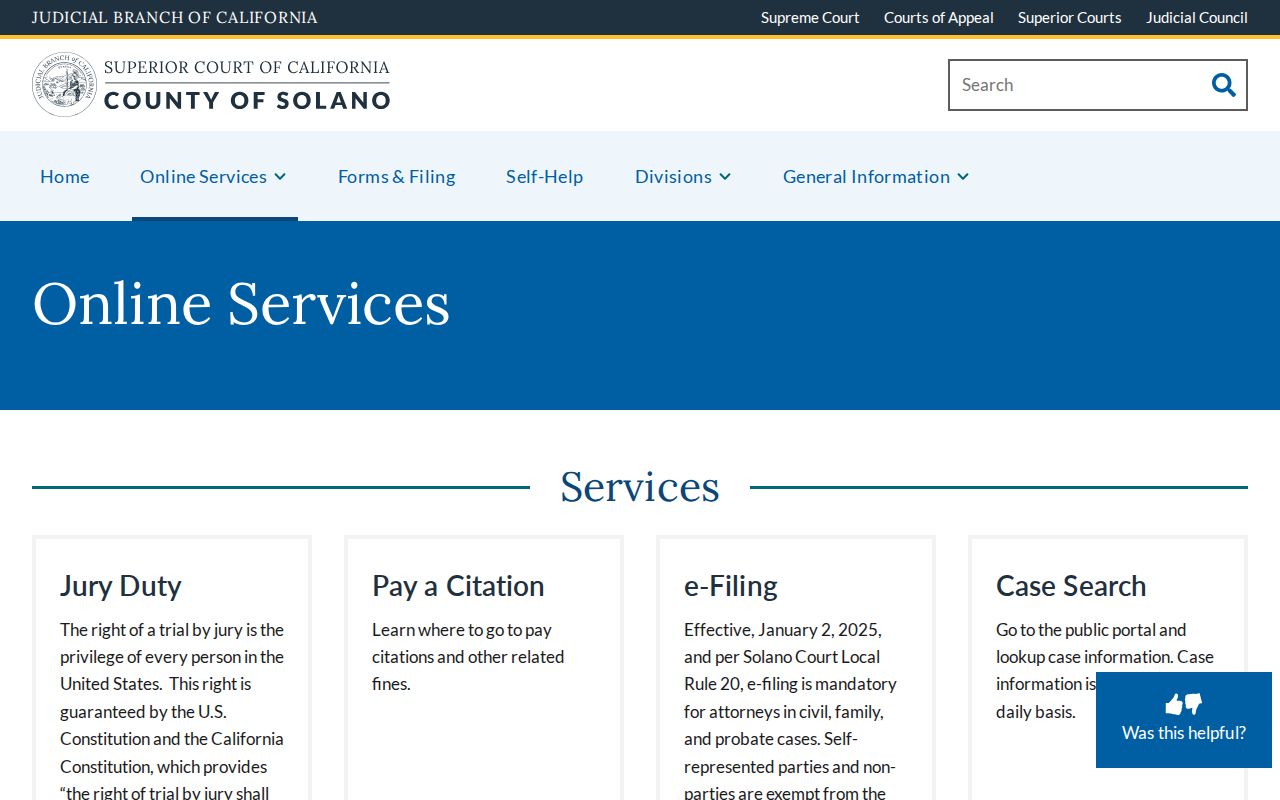
When you request a file, carry the case number and division from the index with you. That detail makes the clerk's copy route far more precise than a broad name request.
California Voter Status and Benicia Resident Checks
California's My Voter Status portal is built for one person: the voter. Enter your first name, last name, date of birth, and, if asked, the last four digits of a driver license or state ID. The tool then returns your own registration status and election details. It has no browse mode. It cannot serve as a general Benicia residents directory, and no lawful substitute exists there for a by-name resident lookup.
The full voter file is a different animal. Elections Code section 2194 and 2 CCR sections 19001-19013 restrict its release to election, scholarly, journalistic, political, or governmental purposes. Approved files can carry names, registration dates, addresses, precincts, districts, and participation history. Ballot choices are never included. Safe at Home participants and other protected voters stay out of the file entirely.
The Registrar of Voters sits at 675 Texas Street, Suite 2600, in Fairfield, open weekdays from 8 a.m. to 5 p.m. A proper file request must state the requester, purpose, geography, and choices on inactive records and history, and it needs an original wet signature plus an identity attachment. State review runs an estimated 7-14 business days. Published pricing is $15 per thousand records, capped at $100, or $30 for a specific record, also capped at $100 for up to ten.
Note: A voter-file statistic can describe the county file, but it cannot be read as a Benicia household count.
Benicia Vital Records and Informational Copies
California vital records do not open on a fixed schedule. There is no rule that every certificate becomes public after so many years. For recent births, deaths, and public marriages, Health and Safety Code sections 103526 and 103526.5 draw a line between an informational certified copy and an authorized certified copy. Anyone may request an informational copy. An authorized copy demands a qualifying relationship and a sworn statement, with notarization on the stated mail route. Confidential marriages sit tighter still under Family Code section 509.
Solano County and the California Department of Public Health run separate issuing routes, and costs differ. For 2026, the county lists $34 for a birth certificate, $26 for death, and $19 for public marriage. CDPH posts $31, $26, $19, and an $18 divorce certificate. Walk into the county office and the record is usually handled that visit. The state route averages four to six weeks for a certified copy. Mail requests need the current application, payment, and any required sworn statement.
Keep the purpose straight. Vital records prove an event or family tie, not where someone lives now, so they will not replace a Benicia residents directory for current addresses. An informational copy carries a mark noting it cannot establish identity. Divorce decrees live with the Superior Court; a CDPH divorce certificate is a separate, simpler product. Confirm the current county or state form before relying on any fee, timeline, or eligibility rule.
Benicia Cemetery Index from 1849-2007
The Benicia City Cemetery keeps a municipal A-Z index that can outlast any printed directory. Coverage runs from 1849 through 2007. Each entry gives a name, dates, an age, and a coded grave location. Sections span Main, Carquinez Gardens, Lawn, and Urn. The older Main area breaks down into Pioneer, Catholic, Central, St. Paul's, and Masonic subdivisions. A grave location alone proves no one's full residence history. It does anchor a death date, a family name, or a neighborhood thread. That thread is worth pulling in the wider Benicia residents directory.
Pull that thread through the Benicia Public Library newspaper run. Three titles spanning 1899 to 1977 may tie a burial to an address. The link may come through a death notice, sale, club report, or move. The Solano County Genealogical Society deepens the trail with cemetery and church indexes, a Great Register run from 1866 to 1968, a death database covering 1850 through 2016, naturalization material, deeds, courts. Newspapers round it out. Those dates describe each series. They do not promise that every person survives in the records.
Note: A cemetery location is a historical clue, so pair it with a dated notice or family record before naming a household.
Benicia Business and License Clues
Affiliation records sort out same-name people. That helps when a business, trade name, or credential enters the picture. California bizfile searches by name or file number. Results can show an entity number, status, jurisdiction, filing dates, agent, principal and mailing addresses, and disclosed officer, director, member, or manager names. Solano's fictitious-business-name system works by FBN name, file number, or filed date. A DCA license search adds a licensee name, number, type, and status. Public discipline links appear where the board exposes them.
Remember that a business or license address is not a home address. Treat it as an anchor. Then compare date, city, party role, or family detail against an independent record. Do that before concluding anything about a Benicia resident. The same caution fits the California State Controller's unclaimed-property search. A free name and location lead is useful, but any claim demands proof of identity. California bizfile Online is the official starting point for a business-name clue.
A business-search result pairs an entity trail with one caution: a filing address describes the entity, not necessarily a resident. The California Department of Consumer Affairs license search offers a second official affiliation source when a credential is known.
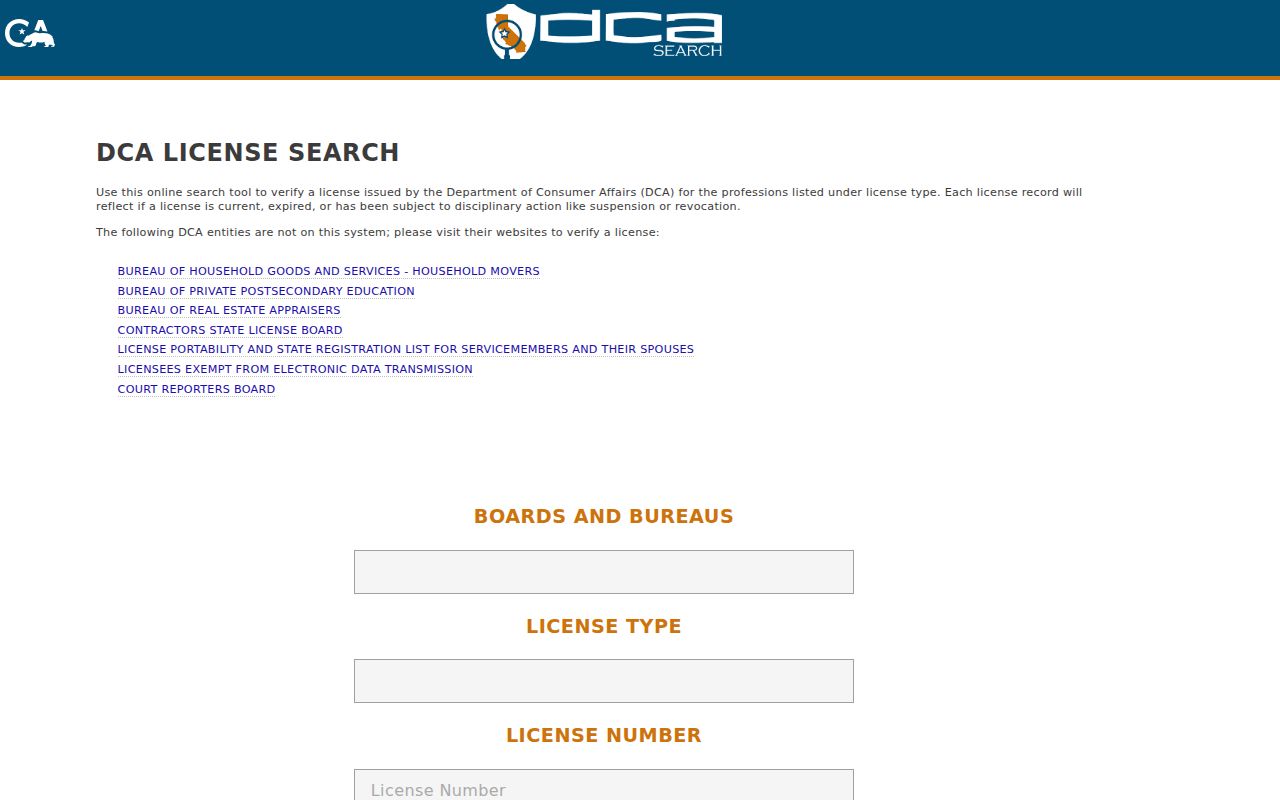
A license result carries the most weight when the license number, board, city, and status all match the other record anchors.
CPRA Requests for Benicia Records
Sometimes a Benicia record exists but is simply not posted anywhere. The California Public Records Act is the fallback. Government Code sections 7920.000-7931.000 cover existing public records, and a well-built request speeds things along. Name the department, the record type, any address or APN, and a date range.
Benicia's City Clerk route can reach ordinances and minutes. It can also reach agreements, permit history, planning applications, code cases, and historic-survey forms. The statute does not force staff to answer a research question. Nor must they create a new resident list from scratch. Agencies generally get ten days to decide whether disclosable records exist. Written notice follows, and a possible fourteen-day extension applies for unusual circumstances. Inspection is usually free, though duplication or a statute-specific copy cost may apply. Privacy, active-investigation, juvenile, voter-authentication, DMV, and vital-record rules can still limit what gets released.
For a Benicia address, ask for an existing permit history. A planning file, code-case record, or survey form also works. That framing works better than asking staff to identify everyone who lived there. Requests succeed more often when the custodian can locate a defined record series.
Benicia Privacy, Safe at Home, and DROP
California's privacy tools each target a different source. The CCPA lets covered consumers know, access, delete, correct, and limit sensitive-information use. It also lets them opt out of sale or sharing, subject to exceptions. None of that erases a deed or court file. It does not erase any other government record kept under a legal duty. The California DROP portal serves registered data brokers. A resident verifies residency, builds a matching profile, and sends one free request. Mandatory broker processing began August 1, 2026, under stated ninety-day deletion and recurring handling rules.
Safe at Home is different. It is an address-confidentiality program for eligible survivors. Those survivors may face domestic violence, stalking, sexual assault, child abduction, elder or dependent-adult abuse, or human trafficking. Members get a substitute mailing address, mail forwarding, a service-of-process agency, and confidential voter registration. The program does not erase data that already exists. Special vital-record exceptions remain. Government Code section 6209.5 offers a route to request substitution. It applies to certain real-property deeds and ownership forms.
Lawful use. Benicia public records are for personal, lawful research, family history, civic understanding, and safety awareness. Do not use a name, address, or record trail to stalk, harass, intimidate, or harm anyone.
Solano County Sheriff custody information shows another boundary. A jail booking log is a transient law-enforcement record, not a complete residents directory.
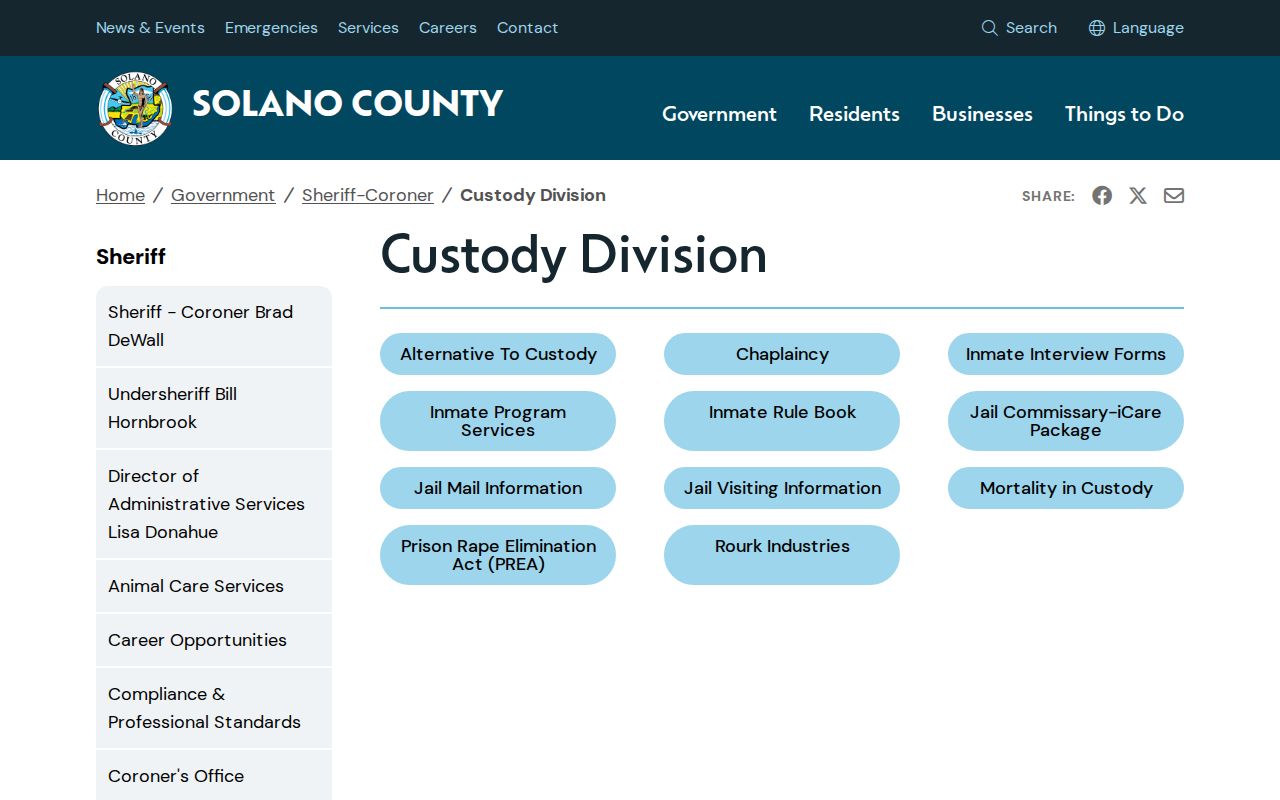
Custody pages sit inside the Sheriff's official record channel. There, public and protected information are separated by law.
Historical Benicia Resident Directories
Benicia's historical directory holdings arrive in scattered issues rather than one continuous run. The earliest verified title is the Solano and Napa Counties Directory for 1871-72. McKenney's 1878-79 district directory lists resident names and, for landowners, acreage plus a post-office address. A handful of other verified issues round out the shelf: an 1874 Solano section, an 1884-85 McKenney issue, and a November 1928 Napa and Solano telephone directory held by the Museum of History Benicia. The library holds licensed city-directory access, though it publishes no complete Benicia inventory.
Newspapers supply the steadier local spine. The Herald runs 1899-1914 and again 1972-1977, Benicia Herald and New Era spans 1914-1957, and Benicia Herald covers 1958-1971. For databases, the library links HeritageQuest, Ancestry Library Edition, and MyHeritage Library Edition, covering census, land, wills, church, school, obituary, map, and directory categories. Ancestry Library Edition works in-library only; remote access hinges on the product and a valid Benicia card.
The Museum of History Benicia counts roughly 29,000 catalog entries and growing. Photographs, documents, organizational records, and building narratives there can name people a deed index never captures. The National Archives at San Francisco widens regional access, and the Thomas and West 1874 atlas adds landowner and geographic context. The Benicia city directory collections page keeps the verified issues, newspaper runs, and reading tips for each genre distinct.
The library's local-history collection links tie together historic-property surveys, maps, museum resources, and address-based research routes.
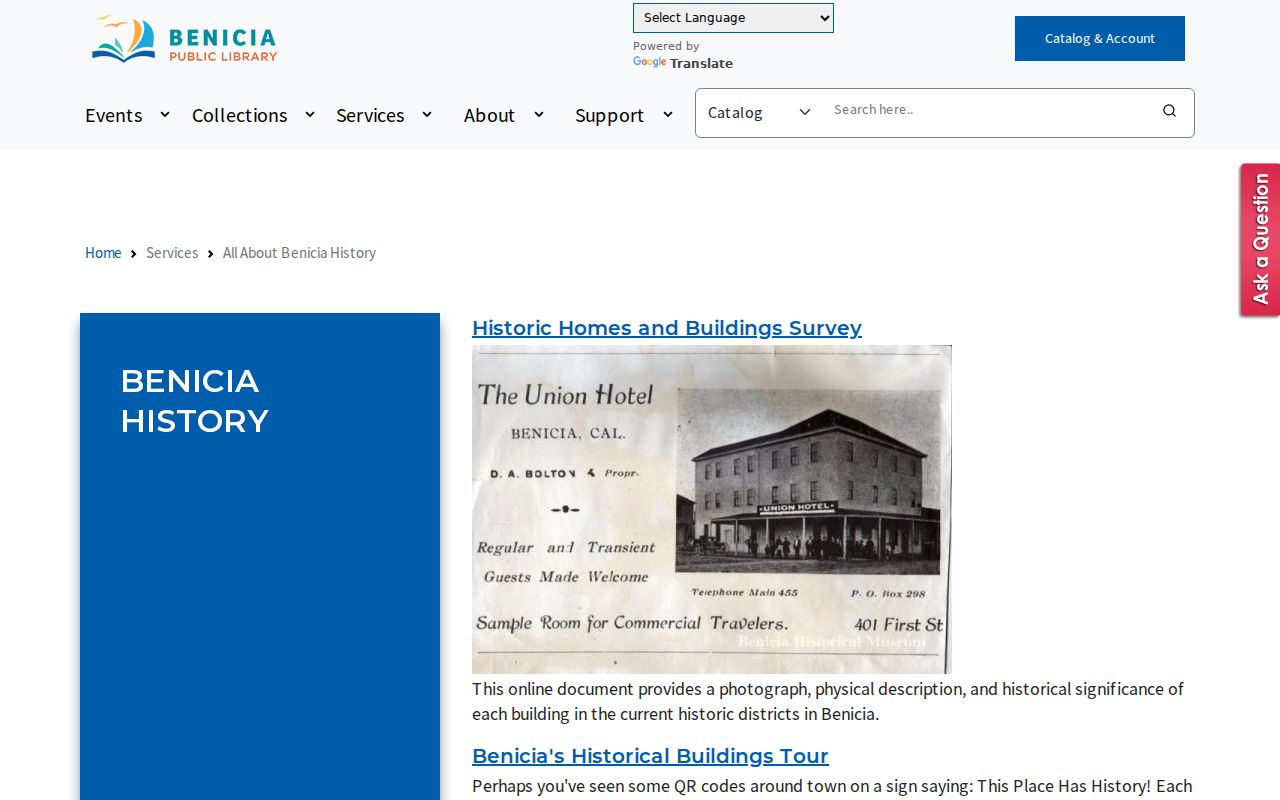
The image traces the address, map, and museum trail. Together those routes bridge current Benicia records and the older resident directory issues.