
What a Benicia Resident Lookup Can Confirm
A resident lookup is a path through records with distinct custodians. A parcel can connect a person to land, but an owner is not automatically an occupant. A court docket can connect a party to a case, but a name is not a unique identifier. A business or license record can confirm an affiliation, while a directory or newspaper can place someone in an earlier year.
| Record | What it can confirm | Where | Access |
|---|---|---|---|
| Assessor parcel | Property link, situs, assessment, and possible mailing lead | Solano property search or counter | Online lead; counter confirmation |
| Recorded document | Deed, lien, easement, party role, and legal description | Solano Recorder | Index online; image counter or mail |
| Court docket | Party name, role, case type, dates, and public status | Solano CourtConnect or clerk | Account, counter, or Form 4021 |
| Voter record | Authenticated status or qualified-purpose file data | California Secretary of State and Registrar | Self-check or statutory request |
| Vital record | Event and family relationship | Solano Recorder or CDPH | Informational or authorized route |
| Business or license | Entity, trade name, credential, or public status | SOS, FBN, DCA | Free public searches |
| Directory, newspaper, or census | Historical household, address, and life-event clue | Library, museum, SCGS, NARA | Collection-specific |
Choose the row that matches the question, then use a second row to test the person, date, and place. That is more reliable than treating one search result as a complete profile.
Benicia Resident Lookup Starts with Two Anchors
Use a complete name plus one non-sensitive anchor: a Benicia address, an approximate year, a spouse or relative, a case number, an entity name, a license number, or a newspaper event. Try initials, prior surnames, punctuation-free names, and spelling variants. A common name needs a place and time before a result becomes meaningful.
Start at the source that fits the clue. An address goes to the property search and parcel map. A court question goes to CourtConnect and then the clerk. A business name goes to bizfile and Solano's fictitious-business-name index. A historical name goes to the Benicia Public Library, Museum, newspapers, cemetery indexes, or SCGS. A birth-parent question belongs with California's official adoption-information process, not a casual public search.
Keep a small result log with the exact spelling, date, source, case or document number, and what the record actually says. The log makes it easier to ask the right custodian for a correction or copy.
Benicia Common Names in Solano Records
A name hit is only the start of a Benicia resident lookup. Compare the recording date and legal description in a deed, the division and party role in a court case, the license number and status in a professional record, or the address and year in a newspaper or directory. A business address, mailing address, and situs address can all differ from a home address.
When a property name is the clue, resolve the address to an APN first, then search the Recorder as grantor and grantee. When a court name is the clue, use case type, filing date, division, and role. When a historical name is the clue, compare relatives and street numbers across more than one dated source. These small anchors are stronger than a broad match.
- Anchor the name to a place or time through a parcel, dated directory, newspaper, license, or known case clue.
- Run spelling variants in the relevant index and record the case, document, license, or filing number.
- Compare a second anchor, such as a date, party role, legal description, relative, or city.
- Ask the custodian for the image, certified copy, correction, or access explanation that fits the record.
- Index versus image
- An index is a locator. The image or certified copy contains the document's fuller text and legal description.
- Docket
- The court's case record of parties, filings, events, and status, not every pleading image.
- Certified copy
- A copy issued and authenticated by the custodian, with a status and fee different from an index view.
- Same-name trap
- A match that lacks a second anchor and may belong to another person.
CourtConnect Is a Benicia Lookup Index
Solano CourtConnect's public index can be searched by party name or case number, with case type, status, and date controls where the division exposes them. A public result may show the caption, party roles, case category, filing date, register-of-actions events, and status. Sealed, confidential, juvenile, adoption, and protected family information is excluded or restricted.
The portal requires a free account for case-data searching. The data updates daily, but a remotely displayed register is not the official record unless electronically certified. A name match needs a case number and division before a copy request is made. Court files remain at the branch where the matter was heard, and counter search hours are weekdays 8 a.m. to 3 p.m., excluding court holidays.
- Identity: case caption and indexed party names or roles.
- Locator: case number and court division.
- Substance: case category, register-of-actions events, and public status.
- Dates: filing date and docket-event dates.
- Documents: an index entry does not guarantee downloadable pleading images.
Solano CourtConnect is the online index route. A clerk can provide the file through the counter or written request when the public screen is not enough.
Benicia Resident Lookup Form 4021
Form 4021 is the written fallback for a court record that needs more than an index line. The form asks for the requester name, mailing address, telephone, division, case number if known, record-search subject, requested copies, certification choice, delivery details, and clerk-use information. A government-issued photo ID is required, and the court limits a person to five cases per day.
Posted charges include $15 per name when a search exceeds ten minutes, $0.50 per page per side, and $40 for certification per document. Mail requests go to the listed civil, criminal, family, or probate division with the payment method and self-addressed stamped envelope stated on the form. Do not treat a no-result screen as proof that no case exists; spelling, date, division, sealed status, or portal coverage can explain the gap.
Solano Form 4021 is the precise request channel for a case file or copy.
Benicia Resident Voter Self-Check
California My Voter Status asks for first name, last name, date of birth, and, when requested, the last four digits of a driver license or state ID. The form authenticates the voter and returns that person's status and election information. California's voter-registration guidance is the broader official reference, but it is not a by-name resident lookup and has no lawful street-browse mode.
| First name | Required identity field |
|---|---|
| Last name | Required identity field |
| Date of birth | Required authentication field |
| Driver license or ID last four | Used when requested for identity matching |
| Submit | Returns the authenticated voter's own information |
Elections Code section 2194 limits the separate voter-file request to election, scholarly, journalistic, political, or governmental purposes. Commercial or personal address hunting, harassment, unsecured posting, and unapproved transfer are prohibited; Elections Code section 18109 makes unlawful use a misdemeanor. Protected voters, including Safe at Home participants, are withheld.
The California My Voter Status capture shows the authenticated form rather than a public name list.
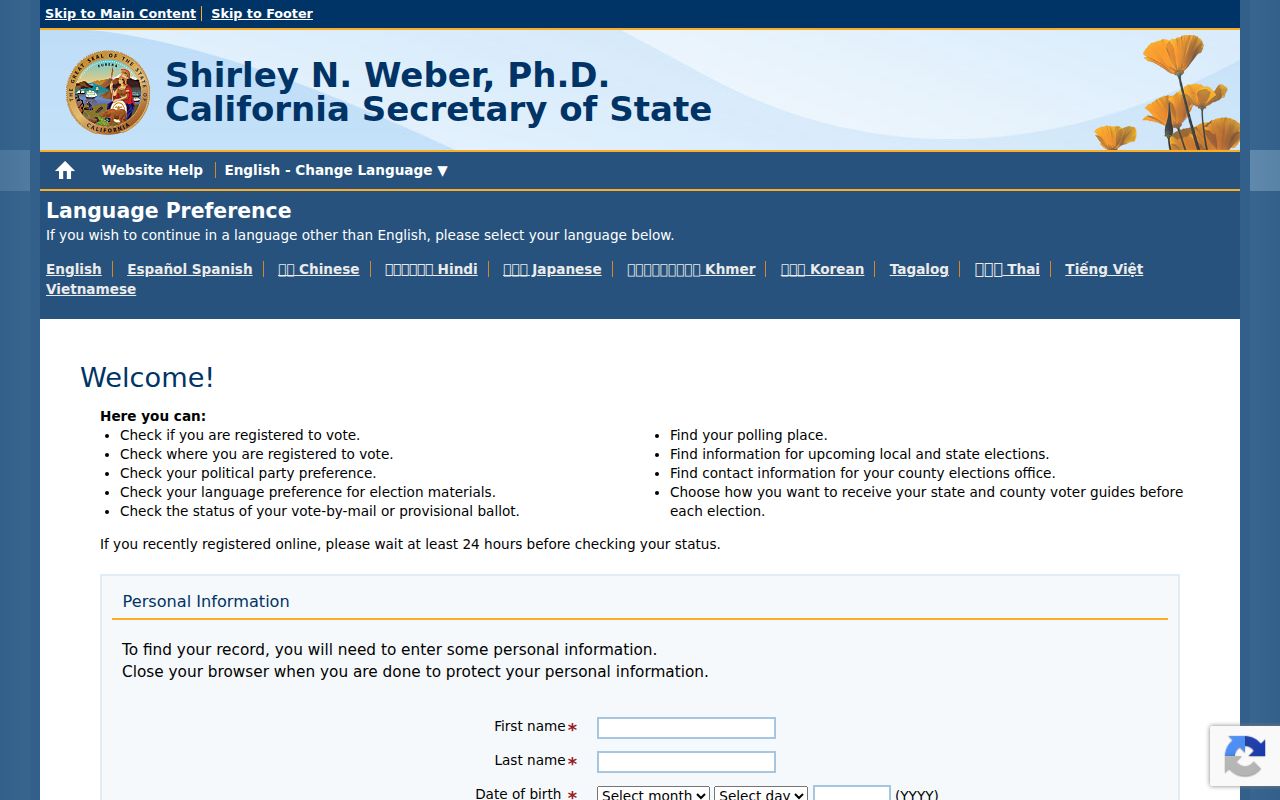
The self-check is useful for the person who can authenticate, not for browsing a Benicia street or household.
Benicia Resident Vital Copies
California vital access turns on the kind of copy requested. Anyone may request an informational copy of a birth, death, or public-marriage record. An authorized certified copy requires an eligible relationship and sworn statement under Health and Safety Code sections 103526 and 103526.5. Confidential marriage records are restricted under Family Code section 509. Divorce decrees belong to the Superior Court, while a CDPH divorce certificate is a different product.
Solano County and the California Department of Public Health vital-records program offer different issuing routes. Solano County reports 2026 charges of $34 for birth, $26 for death, and $19 for public marriage certificates. The CDPH fee schedule lists $31, $26, $19, and $18 for a divorce certificate. County in-person service usually handles a record on the visit, county mail processing is posted at 5-15 business days, and the state reports a four-to-six-week average for certified copies. Current forms control fees, sworn statements, and eligibility.
An informational copy is marked not valid to establish identity. Use a vital record to confirm an event or relationship, not as a shortcut to a current residence. For an heir or family-history question, pair the certificate route with probate, obituary, directory, or cemetery evidence.
Benicia Heirs, Classmates, and Resident Trails
Different personal goals call for different records. An heir search can begin with a decedent's probate docket and petition, then move to an obituary, cemetery index, or family relationship record. Addresses in a probate filing may be redacted or stale, so the docket is a lead rather than a current contact record.
A former classmate or community contact may surface in the library's yearbook and directory databases, the 1899-1977 Benicia newspaper run, or Museum photographs and organizational records. A birth-parent search must use California's official adoption-information and reunion procedures or a court process. Confidentiality cannot be bypassed by combining public clues.
The Solano County Genealogical Society adds church and cemetery indexes, Great Registers from 1866-1968, naturalization indexes from 1851-1962, a death database from 1850-2016, and deed, court, and newspaper material. These collections can reconnect family and community networks without claiming to be a complete resident roll.
Benicia Business, License, Resident Clues
California bizfile's default search accepts a name or file number. Advanced fields add entity type, status, initial-filing date, and public-company disclosure. A result can show the legal entity, state number, status, jurisdiction, principal and mailing addresses, agent, statement date, and disclosed officers or managers. Solano's FBN search adds a trade-name route, while DCA searches by licensee, number, business name, board, license type, city, county, status, or discipline filters.
These records confirm a filing, trade name, or credential. They do not prove that a business address is a home or that a licensee currently lives in Benicia. The State Controller's unclaimed-property search is another free name and location lead, but a claim requires identity proof.
The Solano FBN search is useful when a trade name is the starting clue.
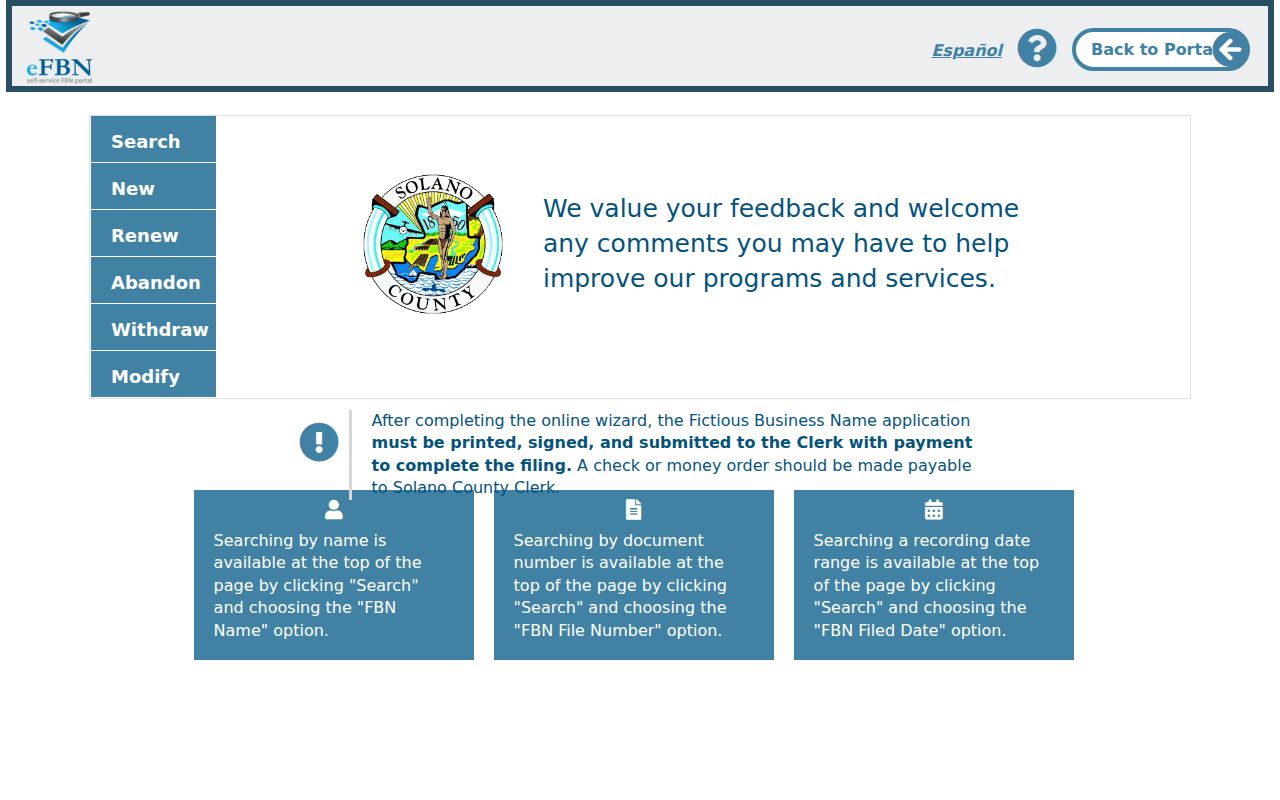
The FBN capture shows a county filing path that can distinguish a trade name from a person with the same name.
California unclaimed property search supplies a separate name and reported-location clue.
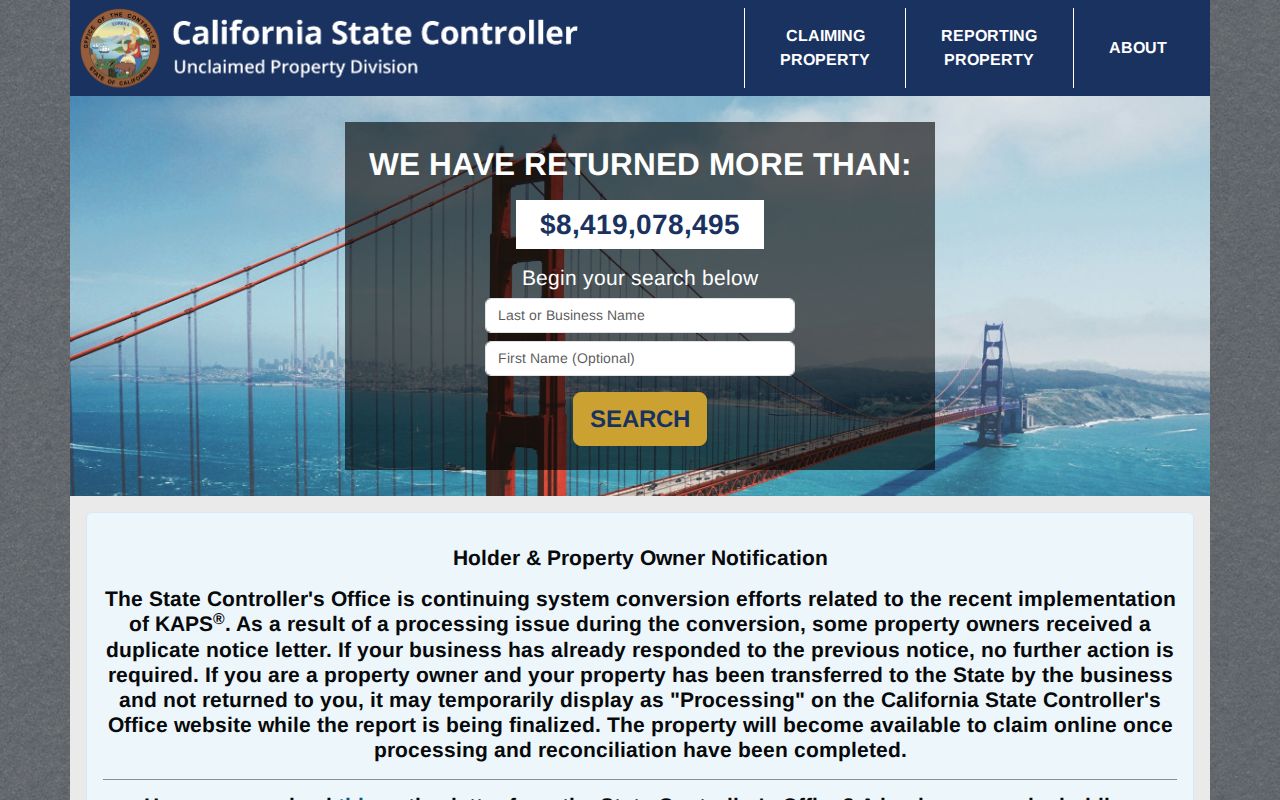
Use an unclaimed-property result as a lead only, and keep the identity proof with the State Controller.
Benicia Registry Results and Resident Proof
California's CDCR inmate locator, Megan's Law public site, and local custody records answer law-enforcement questions, not the broad question of who lives in Benicia. CDCR searches by last name or CDCR number and may show a name, age, number, location, admission date, commitment county, parole-eligible month or year, and certain Board of Parole Hearings actions. Local jail custody belongs to the Solano Sheriff, and federal custody belongs to the Bureau of Prisons.
California Megan's Law carries its own legal-use warning. Dynamic registry fields were not verified in the research capture, so a result should be read through the official site and not expanded into an unsupported claim. A name match can be wrong; agency identifier and age or date details are the proper disambiguation anchors.
California Megan's Law is the official registry route.
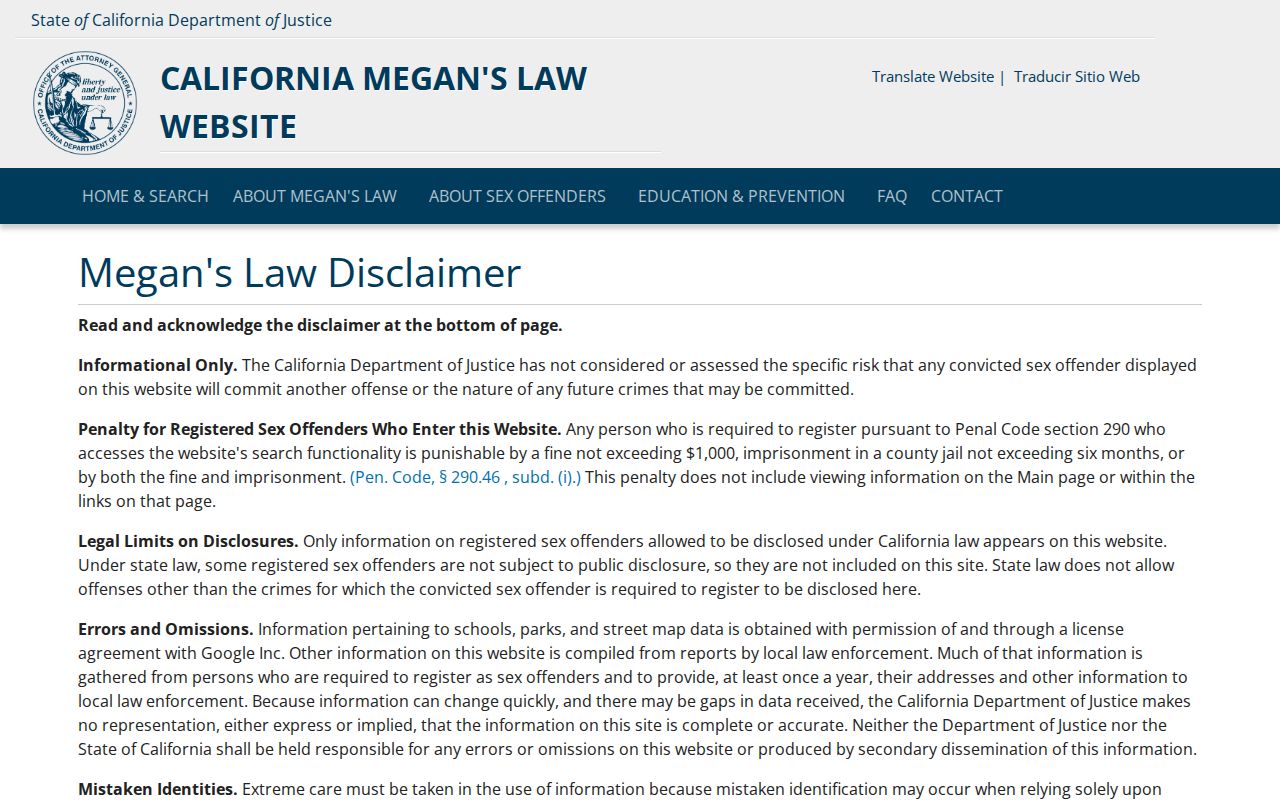
The registry capture is a reminder to follow the official use notice and keep the result within its stated purpose.
Legal Limits on a Benicia Resident Lookup
A lawful Benicia resident lookup is for personal research, family history, reconnecting, civic understanding, or safety awareness. California restricts voter-file purposes, protects DMV data, seals or limits juvenile and family records, and provides Safe at Home confidentiality for eligible participants. The CCPA's broker deletion rights do not rewrite a deed, docket, or certificate held by a government custodian.
Lawful use. A name match is not permission to pursue a protected person or expose private details. Do not use records to stalk, harass, intimidate, or harm anyone; take corrections and access questions to the office that holds the record.
For a property error, contact the Assessor or Recorder. For a docket, contact the court clerk. For a license, contact the licensing board. For voter confidentiality, contact the Registrar or Safe at Home. If the goal shifts from one person to everyone along a road, the Benicia street directory addresses the parcel chain without claiming a complete household list.